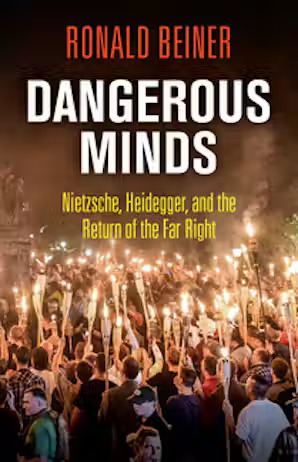
Ronald Beiner, Dangerous Minds: Nietzsche, Heidegger, and the Return of the Far Right
Résumé
Following the fall of the Berlin Wall and demise of the Soviet Union, prominent Western thinkers began to suggest that liberal democracy had triumphed decisively on the world stage. Having banished fascism in World War II, liberalism had now buried communism, and the result would be an end of major ideological conflicts, as liberal norms and institutions spread to every corner of the globe. With the Brexit vote in Great Britain, the resurgence of right-wing populist parties across the European continent, and the surprising ascent of Donald Trump to the American presidency, such hopes have begun to seem hopelessly naïve. The far right is back, and serious rethinking is in order.
In Dangerous Minds, Ronald Beiner traces the deepest philosophical roots of such right-wing ideologues as Richard Spencer, Aleksandr Dugin, and Steve Bannon to the writings of Nietzsche and Heidegger—and specifically to the aspects of their thought that express revulsion for the liberal-democratic view of life. Beiner contends that Nietzsche's hatred and critique of bourgeois, egalitarian societies has engendered new disciples on the populist right who threaten to overturn the modern liberal consensus. Heidegger, no less than Nietzsche, thoroughly rejected the moral and political values that arose during the Enlightenment and came to power in the wake of the French Revolution. Understanding Heideggerian dissatisfaction with modernity, and how it functions as a philosophical magnet for those most profoundly alienated from the reigning liberal-democratic order, Beiner argues, will give us insight into the recent and unexpected return of the far right.
Beiner does not deny that Nietzsche and Heidegger are important thinkers; nor does he seek to expel them from the history of philosophy. But he does advocate that we rigorously engage with their influential thought in light of current events—and he suggests that we place their severe critique of modern liberal ideals at the center of this engagement.
Source : https://www.pennpress.org/9780812250596/dangerous-minds/
Note Fred
Ronald Beiner est prof de sc. po. à l'Université de Toronto et nous livre ici un petit ouvrage fort dense passionnant, qui traite des sources philosophiques et intellectuelles des inspirations de l'Alt-Right US - et, plus largement, des protos-fachos voir nazis avérés qui se multiplient ces temps sur la planète comme la méchante peste brune qu'ils sont.
Avec une franchise désarmante et une approche très incisive à l'anglo-saxonne, ce fripon a déconstruit mon image du grand Nietzsche - non, Foucault et ses contempteurs n'avaient pas raison, le grand philosophe n'a jamais, au grand jamais, été de gauche - plutôt un nostalgique d'une noblesse imaginaire, toute faite de clichés éculés.
“We need to commence a serious engagement with Nietzsche and Heidegger because, in the end, these thinkers are not the resources for the left that we have so often been told that they are. In a longer-term view, they are more likely to be resources for the right and far right.”
Il y montre le lien intéressant entre la Russie Ieltsinienne et l'Amérique de Trump I (et bien sûr de son triste clown clone Trump II):
“Clover, in Black Wind, White Snow, writes the following about the ideological landscape in Russia during the Yeltsin years: “For many provincial Russian youths, languishing in stultifying mining towns and crushing poverty, the NBP [the neofascist political party co-led by Dugin and Eduard Limonov in the 1990s] offered a rush of adrenaline.” It seems strange to think that there could be anything in common between Yeltsin-era Russia and contemporary America; yet ideologically, surveying the scene in 2017, it does seem as if there is some kind of thread joining them. Let me try out my own version of Clover’s sentence (which may be a highly imperfect parallel in all kinds of ways and yet may still capture something important): “For many young people in the suburbs and small towns of the American heartland, facing the despair of unemployment or the even worse despair of stultifying and meaningless work in anonymous offices, the alt-right offers a rush of adrenaline.””
Avec son disciple Heidegger, ces deux demeurés ont posé de fort solides briques sur lesquelles les fascistes ont construit leur pseudo-raisonnement - eux pour qui la Raison est l'ennemi ultime.
Et les récents sinistres clowns trumpiens ou poutiniens (j'arrête ici la liste de néologismes qui s'allonge malheureusement) se sont contentés de plaquer ces idées sur un discours récent, en transformant juste le judéo-bolchévisme en islamo-gauchisme.
Édifiant, donc, et inquiétant.
Notamment parce que la solution proposées pour lutter contre ces pauvres gars est pas franchement sexy:
“So here’s my proposal. We must read the great antiliberal theorists—Rousseau, Marx, Nietzsche, Heidegger, and, yes, even Joseph de Maistre—not in order to appropriate them for liberal or leftist intellectual projects but in order to come to a deeper understanding of precisely why they turn their backs on bourgeois liberalism and hence why many of our fellow citizens are readily tempted to do the same. All the best theorists have, of course, always done this. But I’m inclined to think that, especially in recent decades, the confidence of the liberal West in the moral truth of the liberal-egalitarian dispensation and its idea of justice has duped theorists into thinking that this enterprise of radical and comprehensive philosophical dialogue is no longer essential. Hopefully, the shock of the populist-nationalist backlash we are currently seeing will jolt theorists, intellectuals, and citizens into recognizing what often turn out to be tacit and unconscious end-of-history assumptions. As I hope is illustrated by the commentaries on Nietzsche and Heidegger presented in this book, an honest dialogue with these thinkers requires that we take them seriously without in any way liberalizing or whitewashing their most appalling and most illiberal ideas. If we fail to grasp what these enemies of the democratic Enlightenment are really saying, then we’ll (deservedly) get sucker-punched by thinkers or doers less shy about taking them at their word.”